OEE software and CNC production tracking for turning industry professionals
Whether you are equipped with CNC machines or cam-operated machines, Atsora provides you with reliable, real-time visibility into your production. CNC production tracking, machine data collection, OEE calculation, cycle time, utilization rate: everything is measured directly from machine data, without manual entry or approximation. In an environment as demanding as turning, the reliability of data determines industrial performance.
Summary
Modern turning requires rigorous control of rhythms, settings, downtimes, and quality, in workshops where operators often manage multiple machines and where the fleets combine CNC, cam machines, and heterogeneous technologies. Atsora Tracking provides reliable, real-time visibility across the entire fleet by directly leveraging machine data, without manual entry. The solution unifies production states, accurately measures settings, ensures automatic piece counting, detects micro-stops, and structures the analysis of downtimes and maintenance. The result: more responsive management, truly comparable OEE/OEE/OEE indicators, and secure production based on factual foundations, tailored to the specific constraints of turning.
A complete overview of the entire machine fleet
High industrial standards
Turning is a high-precision industrial environment. Small parts, high speeds, short or very long runs, frequent changes: performance relies on mastering adjustments, cycle stability, and the accuracy of indicators (OEE, OEG, OEE). Without reliable data, it is impossible to sustainably improve machine performance.
The constraints of a heterogeneous machine park in turning
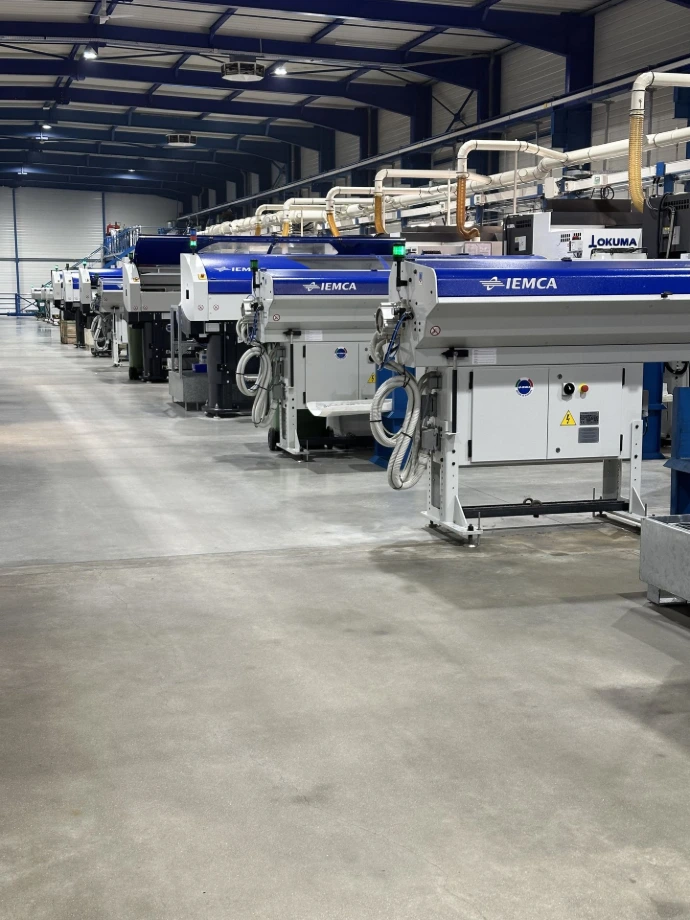
Turning workshops often combine cam machines and CNC machines. CNC machines offer flexibility and programmability. Cam machines remain remarkably efficient in large series but are poorly instrumented. On the CNC side, the parks can be homogeneous or heterogeneous (Fanuc, Siemens, Heidenhain...), making the collection and analysis of machine data complex. This diversity makes calculating the OEE of the machine park particularly delicate if the states are not standardized.
Unifying machine data to improve OEE
Atsora Tracking unifies this environment.
CNC machines are connected through their native data. Cam-operated machines can be equipped with a hardware module to report machine states and automatically count produced parts.
The result: a consistent, reliable, and actionable view of the entire machine fleet.
Production states: immediate visibility
In Swiss-type machining, knowing the real status of the machines is strategic. Production in progress, setup, quality validation, or stoppage—each phase directly impacts scheduling and delivery times.
Atsora automatically identifies precise machine states based on signal analysis. Machining phases are clearly distinguished (automatic, manual, etc.), as are short stops. Setup periods are measured accurately. The “waiting for quality department approval” status makes it possible to integrate quality validation into the analysis. Actual production time is separated from non-productive time.
Data no longer relies on manual reporting.
They reflect the reality on the shop floor, in real time.
Scheduling becomes more reliable. Delays are immediately visible. Decisions are made based on facts.
Mastering setups to secure profitability
Setup time directly determines the economic performance of a production run. In small and medium batches, it can represent a significant portion of the total time. Even in large-scale production, poorly controlled setups lead to quality deviations and loss of throughput.
Atsora measures these periods precisely, distinguishes intervention and validation phases, and enables analysis of variations by machine, by team, or by part reference.
Operations are no longer managed based on estimates.
Operations are driven by objective data.
Execution, part counting, and stoppages: gaining control of daily shop floor operations
Atsora provides reliable visibility into operator activity, produced parts, and losses, enabling precise and responsive management of a Swiss-type machining workshop
A multi-machine organization that requires precise management
In Swiss-type machining workshops, operators often supervise several machines simultaneously. They manage tool changes, material supply, and in-process quality inspections during production.
In this context, manual traceability is inherently imprecise
Atsora automates event data collection. Each machine is monitored individually while maintaining a global view of the workshop. Micro-stoppages become visible, throughput deviations are identified, administrative workload is reduced, and accuracy increases.
Automatic part counting: a critical challenge
Parts produced in Swiss-type machining are often very small. Counting can become approximate, especially when it relies on operator declarations or estimates.
Atsora ensures automatic and reliable part counting, either through machine data or through dedicated sensors installed on cam-operated machines. This accuracy enables precise tracking of produced quantities, actual production rates, and deviations from targets.
A simple piece of data, yet a decisive one.
Stoppages and maintenance: moving from observation to anticipation
Downtimes, whether related to breakdowns, tooling, or materials, directly impact productivity and your OEE. The micro-downtimes, frequent in high-speed environments, often represent an invisible loss.
Atsora automatically classifies stoppages, analyzes recurring patterns, and highlights the dominant causes. Reliability indicators by machine help guide preventive and corrective maintenance actions.
Maintenance becomes data-driven rather than driven by urgency.

OEE, OOE, TEEP: a comprehensive and structured view
Atsora calculates the main industrial performance indicators: OEE, OEG, OEE. These indicators are built from the actual data from the machines, integrating production, adjustments, downtimes, and effective speeds.
They provide a clear view of availability, performance, and losses.
They facilitate dialogue between production, methods, and management.
The workshop finally has a faithful photograph of its actual performance.
A scalable solution, connected to your ecosystem
Atsora is continuously evolving. Detailed scrap management and in-depth analysis of quality-related causes are currently under development, as part of Atsora’s continuous improvement approach—particularly to further refine the accuracy and granularity of performance calculations.
The solution can also leverage ERP or MES data to contextualize analyses: production orders, part references, and theoretical cycle times. The indicators gain greater consistency and depth.
Thanks to its modular architecture and plugin system, Atsora adapts to any type of Swiss-type machining workshop, whether focused on high-volume production, flexible manufacturing, or mixed CNC / cam-operated machine environments.
Swiss-type machining requires rigor, speed, and precision.
With Atsora Tracking, managing operations becomes simpler. Decision-making becomes more reliable.